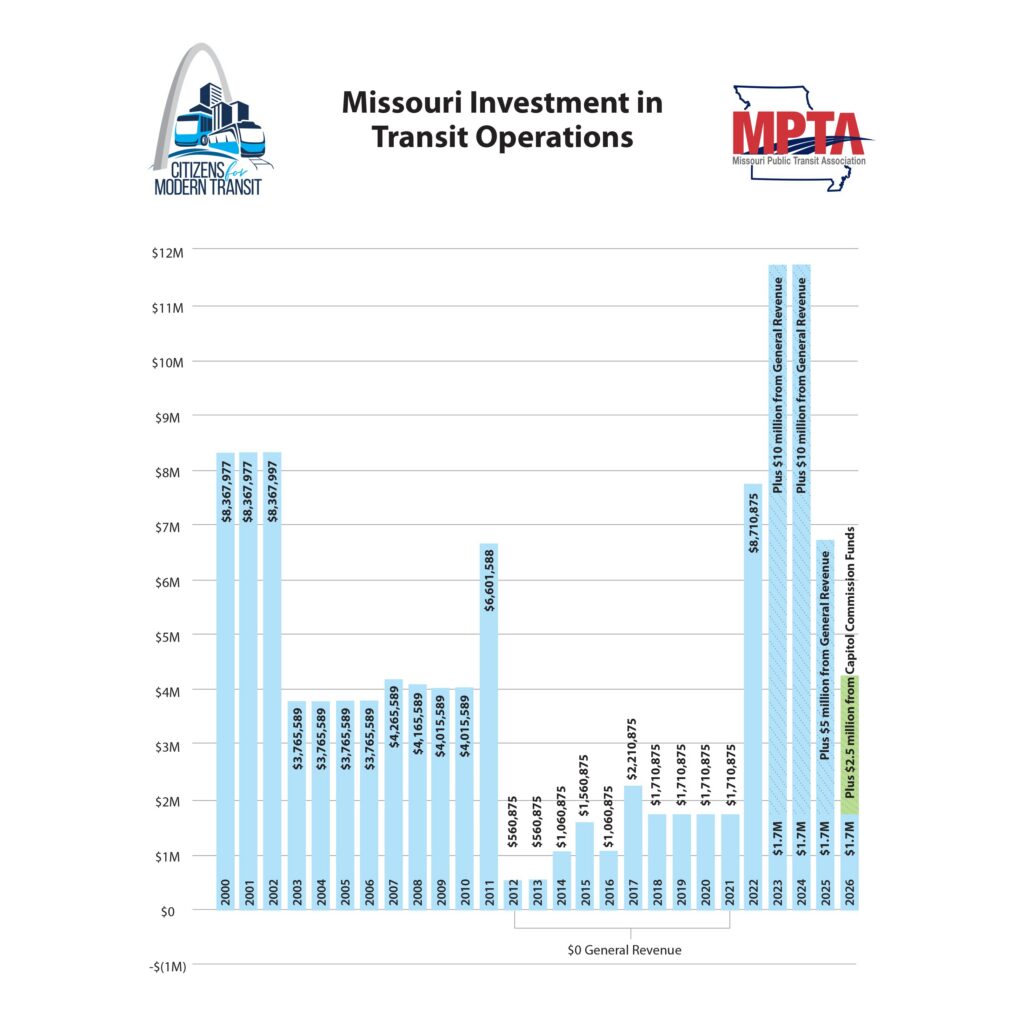
Governor Mike Kehoe today signed the Fiscal Year 2027 (FY27) state operating and capital improvement budget bills. Following a rollercoaster session for public transit investment, the final budget preserves $2.5 million from Capitol Commission Funds for transit, bringing total state operating assistance for public transit to $4.2 million. Link to HB4 here. Microsoft Word – 2004H.06T
The 2026 Missouri Legislative session wrapped the budget process before the May 8 deadline with a second consecutive year of reduced investment in public transit. House Bill 4 (HB4), as approved by the Conference Committee and now signed by the Governor, includes $2.5 million from Capitol Commission Funds and $1.7 million from the State Transportation Fund for transit operations. While this funding represents a 37% reduction from 2025 funding levels, it avoids the deeper cuts originally proposed and reflects a 64% reduction in state transit investment since Governor Kehoe took office.
In January, Governor Kehoe proposed eliminating the state’s $5 million General Revenue support for transit in his FY2027 budget recommendation. Coming on the heels of a 42% reduction in state funding last year, the proposal would have left just $1.7 million to be divided among Missouri’s 30 transit providers for operating assistance. Missouri’s per-capita transit investment had already dropped from $1.89 to $1.08 in the last year — placing the state among the lowest in the nation.
The House Budget Committee supported the Governor’s proposed reduction in its budget released in March. However, Senate Appropriations Chair Rusty Black successfully restored support by including $5 million from the Capitol Commission Funds in the Senate Appropriations Committee’s version of the budget. Ultimately, the Conference Committee reached a compromise, approving $2.5 million from the Capitol Commission Funds in addition to the $1.7 million from the State Transportation Fund.
“Kudos to Senate Appropriations Chair Rusty Black and the bipartisan leadership who understood the need to maintain some level of funding support for public transit,” said Kimberly Cella, Executive Director of the Missouri Public Transit Association. “Are we there yet? No, every cut to transit investment will result in lost service for Missourians, however, being able to hold on to the $2.5 million during a challenging state revenue environment is important.”
“Public transit providers deliver nearly 40 million rides each year across rural and urban Missouri, while also generating $4 billion in economic activity statewide. Restoration of $2.5 million will help ensure Missourians maintain access to reliable transportation. Every dollar matters to every transit provider right now whether they are a rural or urban provider in this state. Without this funding, the impending service cuts or loss of service altogether would disproportionately affect vulnerable populations, including seniors, individuals with disabilities and those living in rural and underserved areas. It means losing access to jobs, dialysis appointments, essential health care services, necessary medications and groceries. Holding on to $2.5 million is a start, but definitely not the end of the transit investment story,” added Cella.
State funding also plays a critical role in helping Missouri transit providers leverage federal transit dollars. These funds provide the local match required to access federal investments made available through the $1.2 trillion Infrastructure Investment and Jobs Act. Federal funding support requires a 50:50 match for transit operations and an 80:20 match for capital projects.
Transit providers across Missouri have worked diligently to identify local matching funds through sales taxes, local government partnerships, private contracts, and other revenue sources. However, insufficient state investment has remained one of the most significant barriers to maximizing available federal funding. Continued state support is essential to ensuring Missouri can fully leverage federal transit investments and maintain safe, reliable, and accessible public transportation services throughout the state.